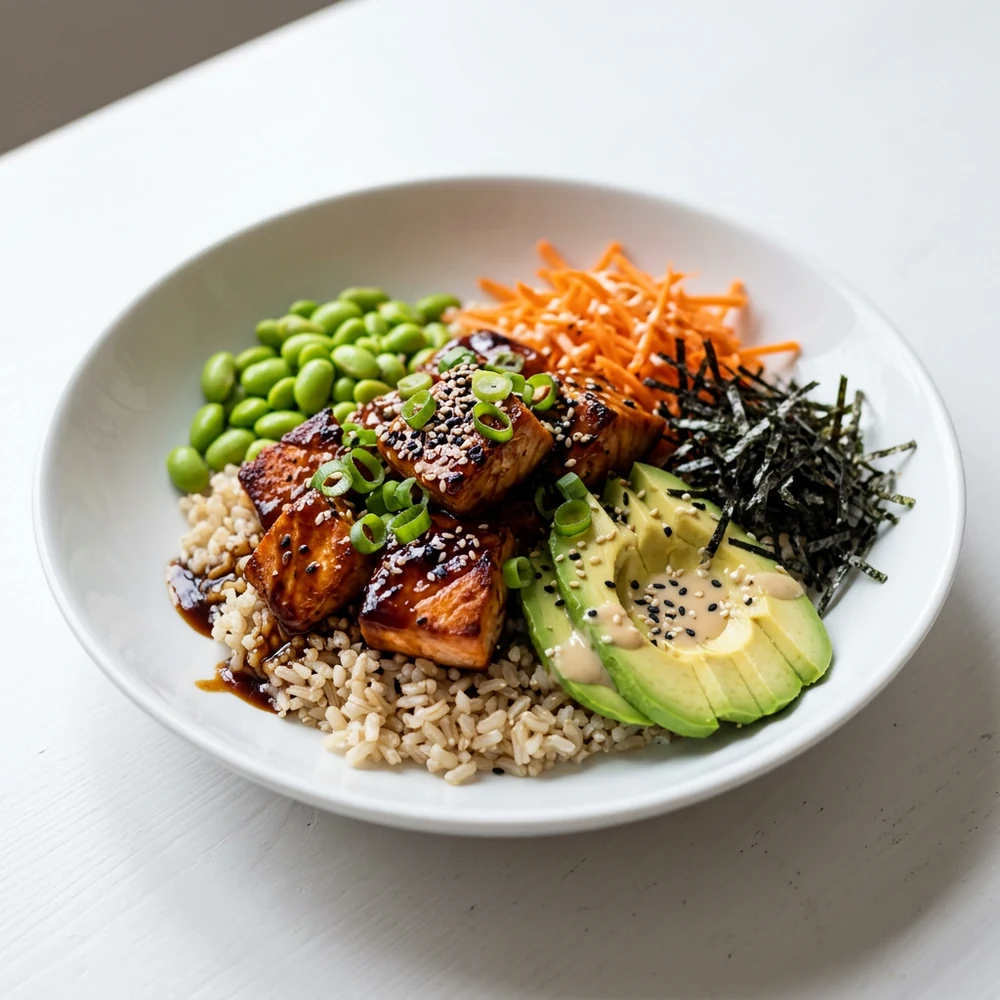
Teriyaki salmon bowl is your takeout order, rebuilt in your own kitchen in under thirty minutes. You sear salmon fillets until the edges go crisp, glaze them in a soy honey ginger teriyaki you mixed yourself, and pile everything over brown rice with edamame, avocado, and carrot.
You need this in your week if your budget is tired of delivery apps, if you want your omega threes without a lecture, or if your household runs on bowl nights. One skillet, one pot of rice, and your Tuesday tastes like your favorite sushi spot’s back room.
Recipe at a Glance
| Prep time | 15 minutes |
| Cook time | 15 minutes |
| Total time | 30 minutes |
| Cooking method | Skillet sear with stovetop teriyaki glaze over rice bowls |
| Servings | 2 |
| Main ingredients | Salmon fillets, soy sauce, honey, brown rice, edamame, avocado |
| Skill level | Easy |
Ingredients You’ll Need
- 2 salmon fillets
- 1/4 cup soy sauce
- 2 tbsp honey
- 1 tbsp rice vinegar
- 1 tsp ginger
- 2 cups cooked brown rice
- 1 cup edamame
- 1 avocado
- 1 carrot shredded
- 1/4 cup nori strips
- sesame seeds
Ingredient Notes & Easy Substitutions
Your salmon: Two fillets, about six ounces each, are your anchor, and skin on is your friend because the skin crisps against the pan and releases cleanly when the fish is ready. Pat your fillets dry before they meet the skillet; a dry surface sears while a wet one steams, and you came here for seared.
Your teriyaki: You are mixing your own glaze because it takes thirty seconds: a quarter cup of soy sauce, two tablespoons of honey, one tablespoon of rice vinegar, and a teaspoon of ginger. Your honey thickens into lacquer as it reduces, your vinegar keeps the salt honest, and your ginger makes the whole kitchen smell like a decision you are proud of.
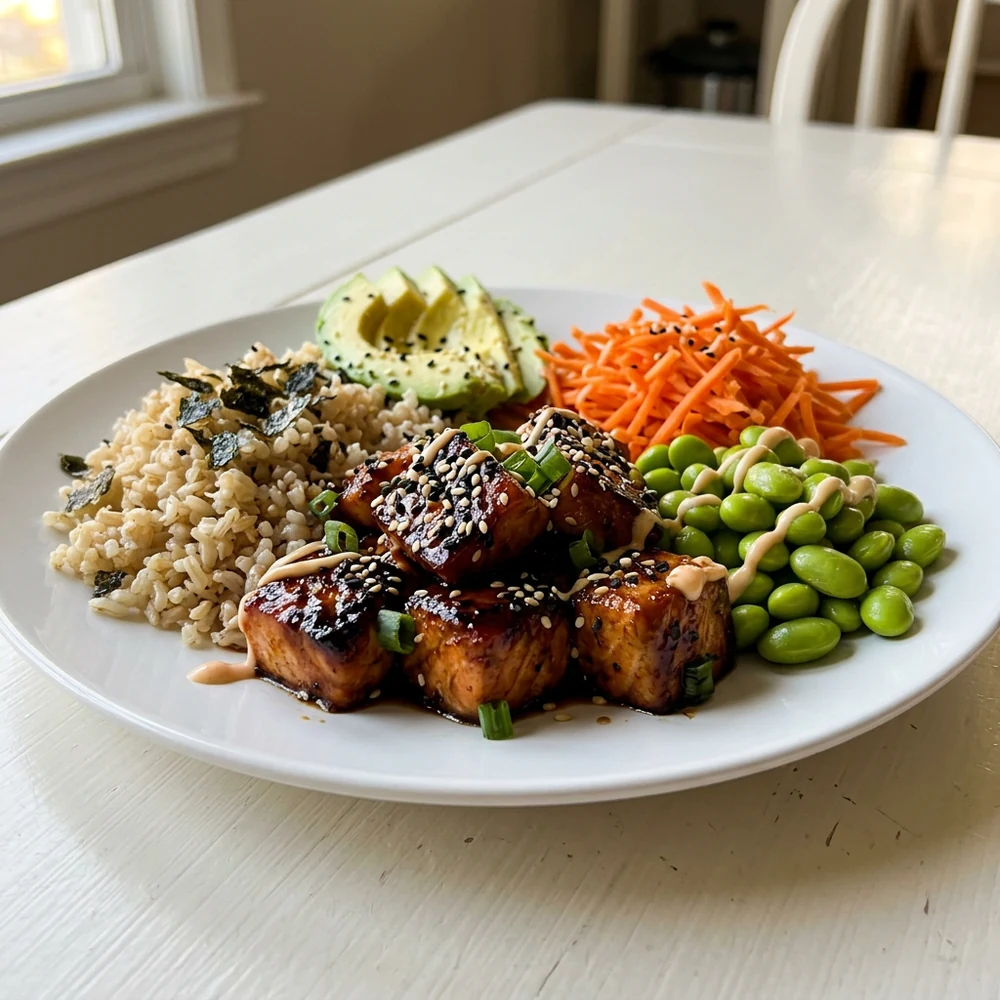
Your rice: Two cups of cooked brown rice make your bowls hearty and keep the energy curve gentle, but your favorite white rice steps in without a word of complaint. Season the rice lightly as it finishes; your teriyaki is salty, so the base should be quiet, not competing.
Your bowl builders: A cup of edamame brings the pop and the plant protein, your avocado brings the cream, your shredded carrot brings the crunch and color, and nori strips with sesame seeds make the whole bowl read like a restaurant built it for you. These are your toppings, so run your own ratios.
Equipment You’ll Need
- Large skillet, preferably nonstick or cast iron
- Small bowl and whisk
- Two wide bowls
- Instant read thermometer, optional
How to Make Teriyaki Salmon Bowl
Step One: Mix Your Teriyaki
Mix the soy sauce, honey, rice vinegar, and ginger in a small bowl for your teriyaki.
Whisk it until the honey dissolves completely into the soy, because an undissolved blob of honey burns where a blended glaze lacquers. Taste it; your mix should be salty sweet with a bright edge, and if you want it hotter, this is the moment for a pinch of red pepper flakes. Your glaze is the whole personality of the bowl, so make it yours.
Step Two: Sear the Salmon
Cook your salmon in a hot skillet for 4 minutes per side.
Lay your fillets in the pan and leave them alone; moving them early tears the crust and costs you the crisped edges you came for.
Four minutes sets a golden underside, your flip goes confidently, and four more sets the second side. Your salmon should flake at the edges while the center still glistens, which is exactly where you want it.
Step Three: The Glaze
Pour your teriyaki over the salmon and cook 2 more minutes, until the sauce thickens and coats the fillets.
Your glaze hits the hot pan and reduces fast, so keep it moving; spoon it over the fillets as it thickens and watch it turn from sauce to lacquer in about two minutes.
The honey can go from glossy to burnt in a blink at the very end, so pull your pan the moment the salmon shines. This is the two minutes your whole kitchen smells incredible.
Step Four: Build Your Base
Divide your brown rice among your bowls and add the edamame, avocado, and shredded carrot.
Give each bowl its own little neighborhoods: rice across the bottom, edamame in one arc, avocado fanned against it, your carrot pile bright orange in the last gap.
Arranging your bowl in sections is not just for the camera; every bite you build yourself hits a different combination, and that is the quiet luxury of bowl night.
Step Five: Salmon On Top
Place your glazed salmon on top of each bowl.
Set the fillets proud in the center so the glaze catches the light, and spoon any remaining teriyaki from the pan over the rice, because that pan sauce is liquid gold you already paid for. Your salmon should sit warm and shining above the cool toppings; that hot and cold contrast is the reason bowl night works.
Step Six: Nori and Sesame
Add your nori strips and a sprinkle of sesame seeds over each bowl and serve immediately.
The nori brings the ocean whisper and the sesame brings the toast, and together they make your kitchen version read fully authentic. Hand everyone chopsticks or a fork and step back; your delivery order has been permanently replaced, and your wallet noticed before your taste buds did.
Serving Size & Batch Scaling
Two fillets build two serious bowls, and your recipe scales cleanly by fillet count; three fillets feed three, four feed four, and your teriyaki mix scales with them. Cook your salmon in batches so every fillet keeps its sear rather than steaming in a crowd.
Your ingredient list is one of the cheapest in the healthy dinner category, since rice, edamame, and carrot do the volume work while the salmon spends its budget where it counts. Two restaurant bowls would cost you four times what this whole pan did, and yours came with better glaze.
Making More or Less?
Cooking for one? Cook a single fillet and halve your glaze, or cook both and claim tomorrow’s cold salmon flaked over rice as your professional prerogative; it is genuinely excellent the next day.
Feeding your crew? Set the rice and toppings out in stations and let everyone build their own bowl while you glaze fillets in rounds. Your assembly line keeps the salmon hot, your guests stay busy, and nobody argues about avocado ratios at your table again.
Nutrition Estimate Per Serving
- Calories: about 560
- Protein: 34 g
- Fat: 22 g
- Carbohydrates: 58 g
It is an estimate, not medically precise information, and the numbers here are working for you: salmon fats, brown rice fiber, edamame protein, and avocado all pulling in the same direction. This is a full training day dinner that tastes like a splurge, which is the rarest combination in your rotation.
Common Mistakes to Avoid
The first mistake you can make is moving your salmon too early, because it releases from the pan when the crust forms and not before; patience is your spatula’s best friend. The second is walking away during the glaze minutes, since honey burns fast and burnt teriyaki is a flavor you cannot come back from.
Overcooked salmon is the quiet third mistake, and your check is simple: the flesh should flake at your fork’s touch but still blush at the center. And do not dress your avocado early; slice it at assembly so your bowl arrives green instead of gray.
Troubleshooting Guide
Your glaze will not thicken. Your pan is too crowded or the heat too shy; crank it for sixty seconds and keep spooning. If it still runs thin, stir a teaspoon of cornstarch into a tablespoon of cold water and whisk it in; your lacquer arrives within a minute.
Your salmon stuck to the pan. The fillets were damp or the pan was not hot when they landed. Preheat properly, pat your fish dry, and if a piece grips, give it thirty more seconds; it releases itself when the crust is ready, and forcing it early only costs you skin.
Your bowl tastes flat. It wants acid and crunch; a squeeze of extra rice vinegar over the rice and a bigger handful of carrot fix it in seconds. A scatter of sliced green onion also lifts the whole bowl, and your ginger was probably shy, which is a next round adjustment.
Variations & Customizations
Swap your salmon for chicken thighs with the same glaze, trade your rice for cauliflower rice when you want the carbs down, or add quick pickled cucumber for a sharp bite. Your bowl accepts roasted broccoli, shredded cabbage, and a fried egg on top with equal enthusiasm, and sriracha mixed into your teriyaki makes it a spicy build.
The bowl structure and nori finish from Simple Healthy Kitchen shaped this version, and the hot skillet glaze technique from Real Food with Sarah is why your salmon lacquers instead of steaming. Extra sesame seeds at your table are for the devoted, and you know who you are.
What to Serve With It
Your bowl is a complete meal, but the rotation around it matters. My street corn chicken rice bowl is the other rice bowl your weeknights keep coming back to.
And when your craving swings Korean, my Korean BBQ pork is the skillet dinner that shares this recipe’s big flavor energy. A cucumber salad with rice vinegar on the side keeps your bowl night cool between bites.
Meal Prep & Make-Ahead Instructions
Your teriyaki whisks together up to a week ahead in a jar, and your rice cooks three days out, which means your night of cooking is twelve minutes of salmon and ninety seconds of assembly. Shred your carrot and dice your onion toppings in the morning if your evening runs tight.
For your weekly prep, portion rice and toppings into containers and keep your glaze separate; cook your salmon fresh in the morning or the night before and flake it over cold for a desk lunch that embarrasses the vending machine. Your containers hold four days without a whisper of sadness.
Storage & Leftovers
Your components keep best separately: the salmon in one container for up to three days, your rice for four, and your toppings in their own corner where the avocado cannot sag on anything.
If you have already built the bowl, eat it within a day, because avocado waits for no refrigerator. The glaze thickens in the cold but loosens again with thirty seconds of microwave warmth, and your salmon stays flaky and fragrant longer than you expect it to.
Reheating Instructions
Warm your salmon gently, about 45 seconds in the microwave or four minutes in a covered skillet with a spoon of water, because salmon only needs heat, not a second cooking.
Here is your permission slip, though: cold teriyaki salmon flaked over cold rice with your toppings fresh on top is a legitimately elite lunch, and half this recipe’s fans eat it that way on purpose. Your nori and sesame go on after any reheating so they keep their snap.
Frequently Asked Questions
Can you use frozen salmon? You can, and you should thaw it overnight in your fridge and pat it very dry before it meets the pan; frozen fillets carry surface water that fights your sear. Cooked from properly thawed, your bowl never reveals the fillet’s history.
Can you make this gluten free? Yes; swap your soy sauce for tamari or coconut aminos and check your nori label, and the rest of your bowl is already gluten free. Your glaze behaves identically, so nothing about your technique changes.
What if you do not like salmon? Your teriyaki does not care what protein carries it; chicken thighs, shrimp, or extra firm tofu all lacquer beautifully under the same glaze. Adjust your searing times, keep your glaze watchful at the end, and your bowl keeps its personality.
Can you bake the salmon instead? You can; roast your fillets at 400 for about 12 minutes and warm your glaze separately in a small pan until it thickens, then spoon it over. Your skillet version has the better crust, but your oven version frees your stovetop for the rice.