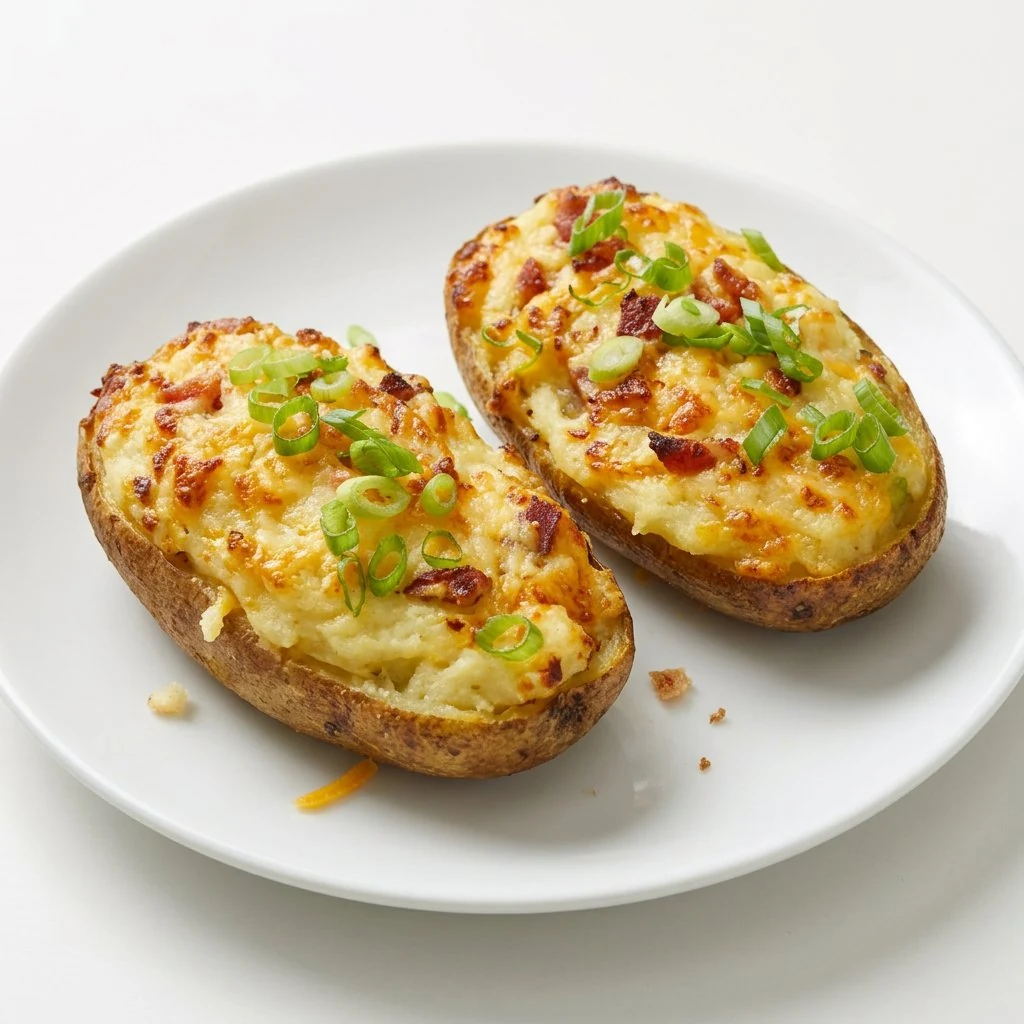
Twice baked potatoes bacon cheddar style are the side dish that makes the rest of your plate look like a warm-up act. You bake russets until fork tender, whip the fluffy flesh with sour cream, butter, and cheese, then pile it all back into the crispy skins for a second trip through the oven.
You need this in your rotation when your regular mashed potatoes have stopped getting compliments, when you want a make ahead side that feeds a crowd, or when your family sees bacon and cheddar on a potato and loses their minds.
Recipe at a Glance
| Prep time | 20 minutes |
| Cook time | 1 hour 50 minutes |
| Total time | About 2 hours 10 minutes |
| Cooking method | Oven baked twice: whole foil wrapped bake, then stuffed skins baked again |
| Servings | 4 stuffed potatoes |
| Main ingredients | Baking potatoes, bacon, sour cream, cheddar cheese, butter, green onions |
| Skill level | Easy |
Ingredients You’ll Need
- 4 large baking potatoes
- 8 slices bacon cooked and crumbled
- 1 cup sour cream
- 1/2 cup milk
- 4 tbsp butter
- 1/2 tsp salt
- 1/2 tsp pepper
- 1 cup shredded cheddar cheese divided
- 6 green onions thinly sliced
Ingredient Notes & Easy Substitutions
Your potatoes should be russets, and you want the big ones, because thin skins will not hold their shape after you scoop and refill them. The cooks at Natasha’s Kitchen warn that unventilated potatoes can burst in the oven, so give each one a few pokes with a fork before the foil goes on and your potatoes stay whole where it counts.
Your sour cream is the tangy backbone of the filling, and whole milk plain Greek yogurt swaps in cleanly if that is what your fridge holds. The cheddar you shred yourself melts better than the bagged kind, because anti-caking starch in pre-shredded cheese makes the topping grainy instead of gooey.
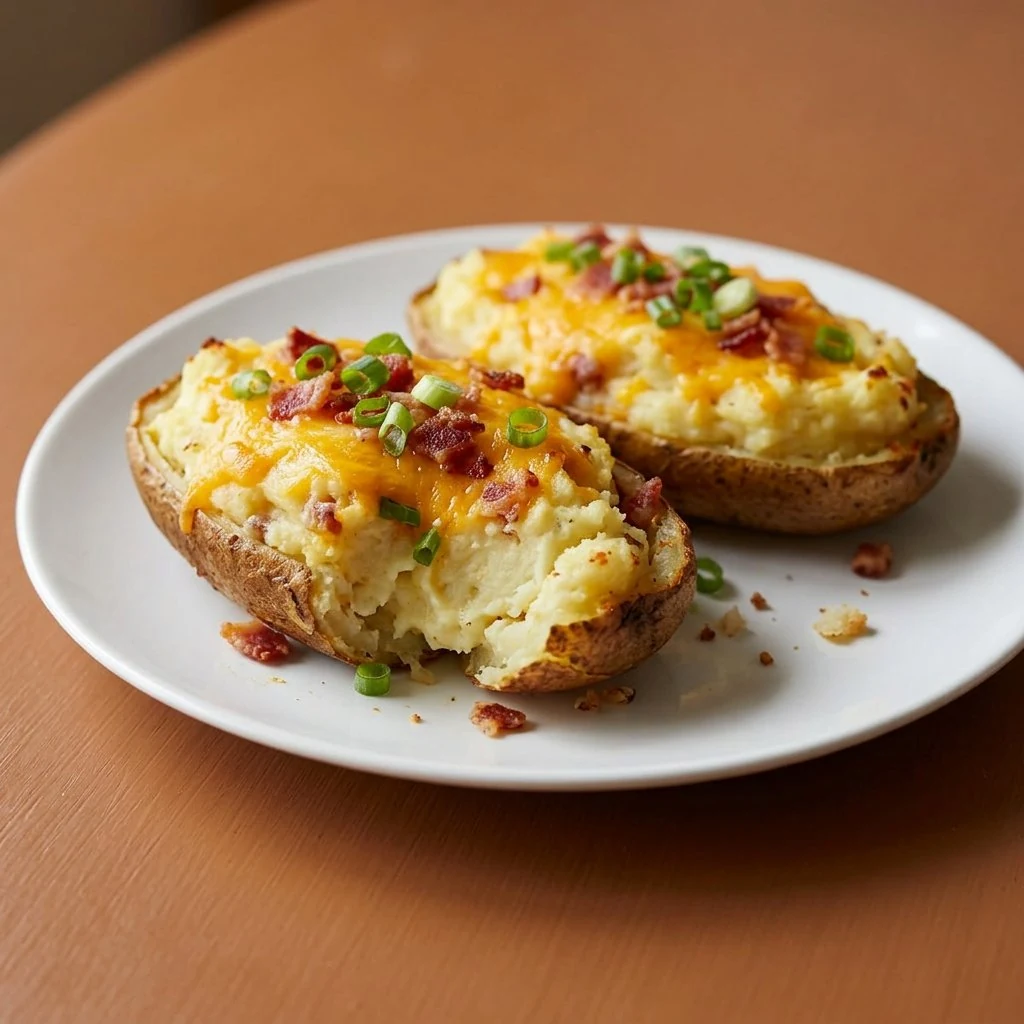
Your bacon should be cooked until crisp before it touches anything, since limp bacon will not crisp up inside a filling. If you have no green onions, finely chopped chives carry the same fresh bite, and buttermilk in place of regular milk adds a gentle tang that plays very well with all that cheddar.
Equipment You’ll Need
You need a rimmed baking sheet, aluminum foil, a sharp knife, a cutting board, a mixing bowl, and an electric mixer, because the mixer is what makes the filling Cloud Mountain instead of rustic mash. A fork for venting, a spoon for scooping, and a sturdy spatula round you out.
If you own a potato ricer, you can run the flesh through it first for an extra silky filling, but your electric mixer already does beautiful work here.
Leave about a quarter inch of potato attached to each skin so your boats stay structurally sound, the same margin the folks at Small Town Woman recommend for skins that never collapse.
How to Make Twice Baked Potatoes Bacon Cheddar
Step One: The First Bake
Preheat your oven to 350F. Wrap each potato in foil, set them on your baking sheet, and bake 1.5 hours until fork tender. Your fork should slide in with zero argument; if it fights you, give the potato another fifteen minutes, because an undercooked center turns gluey the moment the mixer touches it.
Step Two: Cool, Slice, and Scoop
Cool the potatoes 10 minutes, because skins fresh out of the oven will burn your fingers and tear when you cut them. Slice potatoes in half lengthwise, then scoop flesh into a bowl, keeping that thin shell of potato attached so each skin holds its shape like a little edible casserole dish.
Step Three: Build the Filling
Add sour cream, milk, butter, salt, pepper, half the cheese, and half the green onions to your bowl of potato flesh. This is the moment your side dish gets its personality: tang from the sour cream, richness from the butter, and only half the cheese now, because the rest belongs on top.
Step Four: Whip and Restuff
Mix with your electric mixer until creamy, pausing once to scrape the bowl so no lumps survive. Spoon the mixture back into the potato skins, mounding it generously, because the filling settles as it bakes and a proud mound now becomes a perfect rustic peak later.
Step Five: The Full Topping
Top each potato with the remaining cheese, the remaining green onions, and your crumbled bacon. Press the toppings on lightly so they nestle into the filling, because cheese that only balances on top slides off on the journey from counter to table and nobody forgives lost cheese.
Step Six: The Second Bake
Bake at 375F for 15 to 20 minutes until the cheese is melted and bubbly. You are not cooking the potatoes again, you are heating the filling through and melting the top, so pull them the moment your cheese looks glossy and your kitchen smells like a steakhouse sidebar.
Serving Size & Batch Scaling
One large stuffed potato feeds one adult as a hearty side, so four potatoes serve four people generously. If your table includes big appetites or teenagers, plan on some guests eating a whole potato and a half, and adjust your potato count before you preheat, not after.
Scaling is almost linear: eight potatoes double everything, but your first bake may need an extra ten minutes when the crowded sheet traps steam. Use two sheets side by side on separate racks for big batches, swapping their positions halfway through so every potato bakes evenly.
Making More or Less?
For two people, bake two potatoes and mix the filling in a smaller bowl with the same ratios; the mixer whips small batches in under a minute. Keep the sour cream to butter proportions steady and your small batch tastes exactly like the full one.
If you want to stretch the recipe for a buffet, scoop the filling into a greased casserole dish, top it with all the cheese and bacon, and bake at 375F for about 25 minutes. You lose the cute skins but gain a scoopable potato bar that feeds twelve without breaking a sweat.
Nutrition Estimate Per Serving
- Calories: about 540 per stuffed potato
- Protein: 17 g
- Carbohydrates: 54 g
- Fat: 26 g
- Fiber: 4 g
- Sugar: 4 g
- Sodium: about 980 mg

The following is an estimated nutritional breakdown, calculated from standard ingredient databases and not from a lab, so treat these numbers as friendly guidance rather than gospel. Your exact bacon, cheese, and potato sizes will move the totals, and that is completely fine.
Common Mistakes to Avoid
The biggest mistake you can make is skipping the vent holes before the first bake, because sealed potatoes build steam and split open in your foil. The second is overmixing after the cheese goes in; your mixer whips the potato and dairy beautifully, but fold the final cheese in gently or the filling turns stringy.
Do not scoop your skins paper thin, because a skin with no potato backing tears when you refill it and leaks filling onto your sheet. A quarter inch of flesh is the armor that keeps each boat intact, and it crisps up beautifully in the second bake.
Finally, do not underbake the first round out of impatience. Your entire recipe depends on fully cooked, fluffy insides, and fifteen saved minutes costs you a gluey filling that no amount of butter can rescue later.
Troubleshooting Guide
If your filling seems stiff, add milk one tablespoon at a time until it slackens, because potato flour content varies and some russets drink more dairy than others. If it seems loose, it will firm up in the second bake, so resist adding more cheese as a fix and trust the oven.
If your skins tore during scooping, do not panic; patch the hole with a thin shard of potato skin from the scooped flesh and mound filling over it. The cheese topping hides a multitude of patch jobs, and nobody at your table will ever know.
If your cheese browned too fast in the second bake, lay a loose tent of foil over the potatoes for the remaining minutes. Your filling stays hot while your cheese stops darkening, and you still get that bubbly finish you were promised.
Variations & Customizations
Stir two tablespoons of chopped fresh chives and a spoonful of horseradish into the filling for a steakhouse version, or swap the cheddar for pepper jack and add diced pickled jalapenos when your crowd likes heat. Smoked gouda in place of half the cheddar turns these into something you would order at a restaurant and talk about for a week.
For a lighter take that still eats like comfort food, replace half the sour cream with plain Greek yogurt and cut the butter to two tablespoons. Your filling stays creamy from the potato starch itself, and the bacon on top keeps the indulgence flag flying.
What to Serve With It
These potatoes sit happily next to a juicy steak, roasted chicken, or a big green salad when you want balance. They are also a natural partner for loaded potato taco bowl nights when your table has gone full potato and regrets nothing, and they make a meaty cheesy hamburger potato casserole feel like a complete dinner party.
For holidays, serve them alongside turkey or ham and watch them disappear first; twice baked potatoes have a way of upstaging the main event. A simple arugula salad with vinaigrette cuts the richness if your menu needs a fresh counterpoint.
Meal Prep & Make-Ahead Instructions
You can complete everything through Step Five up to two days ahead. Restuff your skins, top them, arrange on the sheet, cover tightly, and refrigerate; when dinner looms, bake straight from the fridge at 375F for about 25 minutes since cold filling needs longer to heat through.
You can also freeze the stuffed potatoes unbaked. Freeze them on the sheet until solid, wrap in foil, and bag for up to a month; bake frozen at 350F for about 40 minutes. The texture softens slightly after freezing, but the cheese and bacon carry the day.
Storage & Leftovers
Leftover twice baked potatoes keep in an airtight container in your fridge for up to four days. Store them in a single layer so the tops do not smear, because your beautiful cheese crust deserves better than being pressed against aluminum foil in a sad stack.
The filling also freezes well on its own for up to two months if you want future you to have a head start. Thaw it overnight in the fridge, spoon it into fresh baked potato skins or a casserole dish, and reheat until hot all the way through.
Reheating Instructions
Your oven at 350F brings refrigerated potatoes back in 15 to 20 minutes, restoring the crisp skin far better than any microwave. If you are in a hurry, microwave a potato for one minute, then finish it in a hot skillet or under the broiler for two minutes to re-crisp the top.
Fresh green onion after reheating wakes the whole potato up, and a small extra pinch of cheese melted on top makes leftovers feel intentional instead of recycled. Your second-day potato is arguably better anyway, because the filling has had time to soak up every flavor in the bowl.
Frequently Asked Questions
Can this be made ahead? Yes, and it is one of the best make ahead sides in your arsenal. Assemble the filled potatoes completely, refrigerate for up to two days, and bake at 375F for about 25 minutes from cold. Your make ahead version tastes identical to the fresh one.
Can you skip the foil on the first bake? You can bake the potatoes unwrapped, and the skins get crisper, but the flesh dries slightly and the bake runs closer to an hour and fifteen minutes at 400F. Foil at 350F steams them gently and keeps your filling fluffy, which is the whole point here.
How do you pick the right potatoes? Choose russets of similar size and weight so they finish at the same time, with tight skins and no green tint or sprouts. Your four potatoes should feel heavy for their size, because a light potato is often already drying out inside.
Can you use bacon bits instead of real bacon? Real bacon is worth the eight minutes it takes, because the smoky chew of actual crumbled slices is doing real work in every bite. Shelf stable bits melt into salt with none of that texture, and your potatoes deserve the upgrade.